The Silent Disco Origin: A Forensic Reconstruction
A research tracing the moment a dormant technology met its missing idea.
Silent Disco did not emerge as a corporate noise solution. It was a radical act of rebellion, liberation, and counterculture — a concept built to let people party anywhere, free from systems, rules, and tradition. For decades, blogs, media, and academic texts have repeated the same wrong origin story. This study corrects the historical record.
SSNR Paper Cambridge PaperSilent Disco History and Origins
Silent Disco Jesus The Pioneer of Silent Disco
This is the primary‑source record of the invention of the Headphone Party — created by the originator of the Headphone Discotheque, long before the term “Silent Disco” existed.
Most online accounts repeat a simplified myth: that Silent Disco began as a noise‑reduction trick for festivals or an eco‑friendly workaround. These stories confuse later utility with the true origin. Silent Disco did not begin as a technical solution. It began as an act of rebellion, freedom, and dance without permission.
## History – Quick Facts
– **Who invented Headphone Party?**
The Headphone Party was conceptually invented by Cisco Sa in the early 1980s.
– **When did Headphone Party start?**
The first Headphone Party experiences began in the early 1980s, shortly after the introduction of the Sony Walkman, which made portable, personal listening widely accessible for the first time.
– **Where did Headphone Party originate?**
The idea originated in Portugal and later evolved, with the concept eventually being hijacked and commercially launched in the Netherlands.
– **Why was Headphone Party created?**
It was a rebellion against dress codes, bouncers, entry fees, and rigid behavioral rules. It was created for liberation, not as a solution for noise complaints, neighbors, or “eco-friendly” nature protection.
– **What came first: Headphone Party or the name Silent Disco?**
The idea and practice existed long before the term “Silent Disco” was coined.

Silent Disco Origin Matrix
Concept vs. Practice vs. Technology vs. Institution
| Dimension | Subcultural Reality | Technical Reality | Institutional Narrative | Analytical Interpretation |
|---|---|---|---|---|
| Core Innovation | Collective dancing via personal audio | RF transmitters & wireless systems | “Silent Disco” as a branded event | Cultural innovation preceded technology |
| Primary Motivation | Escape from exclusion & gatekeepers | Enable synchronized listening | Solving noise complaints & permits | Institutions reinterpret rebellion as utility |
| Origin Form | Informal 1980s Walkman gatherings | Pirate‑radio & mobile broadcasting | Festival deployments (De Parade) | Practices emerge before products |
| Timeline Logic | 1980s–1990s subcultural experiments | Late 90s wireless adoption | 2002–2005 branding rollout | Cultural time ≠ institutional time |
| Evidence Type | Oral memory, lived experience | Hardware logs & frequencies | Media articles & patents | Archives privilege material over memory |
| Meaning of “Silent” | A side‑effect of dancer autonomy | Acoustic property of headphones | Marketing hook & selling point | Outcome mistaken for cause |
| Historical Bias | Marginalized & Undocumented | Partially documented | Fully documented | Power determines what counts as history |
Silent Disco Historical Timeline
This timeline distinguishes the underground invention of collective headphone dancing from its later commercial branding as “Silent Disco,” clarifying the full developmental arc of the phenomenon.
Phase 1 – Conceptual Origin (Underground / Pre-Commercial)
1982–1985 – Walkman Group Dancing (Portugal)
Cisco Sa and friends dance in public spaces using Sony Walkman cassette players and headphones.
→ First documented practice of collective dancing with individual audio and headphones.
1995–1998 – Pirate Radio & Mobile Sound (Netherlands)
Cisco Sa organises and participates in eco activist and pirate radio experiments, broadcasting music to moving/dancing groups.
→ Technical foundation for wireless headphone discos.
1997–2001 – Headphone Discotheque Concept
The idea of combining Walkman autonomy with wireless broadcasting is formulated.
→ Concept of a scalable headphone-based disco emerges.
Phase 2 – Naming & Commercialization (Institutional / Market)
2002 – Term “Silent Disco” Coined (Netherlands)
Dutch promoters Nico Okkerse and Michael Minten brand the concept as “Silent Disco” and organize commercial events at De Parade.
2003–2005 – Festival Adoption
Silent Disco events appear at European festivals; the format becomes standardized.
2005 – Global Popularization
Bonnaroo Festival popularizes the term internationally.
2008–2020 – Industry Expansion
Silent Disco becomes a global event industry with dedicated hardware providers.
Phase 3 – Narrative Conflict (Historical Reinterpretation)
2000s–Present – Wikipedia as the Single Source of History
As the commercial industry expanded, Wikipedia became the default historical reference. Journalists, festivals, and hardware rental companies copied its simplified origin story to satisfy clients and audiences, unintentionally erasing the underground practices that predated the term.
2005–2010 – Noise-Control Narrative Emerges
Media, Silent Disco hardware companies and festivals frame Silent Disco as a solution to noise restrictions.
2010–Present – Wikipedia Canonization
Institutional sources establish the commercial narrative as official history.
2020s – Reclaiming the Origin
Primary-source account challenges the mainstream narrative and restore the underground origins of Silent Disco, highlighting its emergence as a form of cultural and social liberation from the traditional nightclub monopoly — the dancefloor’s own punk rock revolution.
The idea of a disco with headphones started long long ago.
From Walkman Rebellion to a Global Phenomenon
Headphone Party did not begin as a brand, logo, or commercial product. It was an escape — a way to dance without clubs and without rules. It was a lived experience — long before anyone knew what to call it.
In the early 1980s, shortly after the Sony Walkman appeared, music suddenly became portable, personal, and boundless. For Cisco, it was not just a technical gadget but an escape from a nightlife full of barriers: strict dress codes, arrogant bouncers, expensive entry fees, and the constant feeling of “not fitting into the system.” If you didn’t look the part, you didn’t get in. If you danced too wildly, you were thrown out.
Background
So Cisco created his own dance space.
With a Walkman on his belt and headphones on his head, he danced alone — first on the street, then in parks, then with a few friends who brought their own Walkmans and favorite cassette tapes. Everyone listened to their own music. Everyone danced in their own world. And yet, they were together.
It wasn’t called “Silent Disco.” It was simply freedom.
And this is where the true story of Silent Disco begins.
What the 1980s Really Looked Like: The World Before Headphone Party
To understand how extraordinary those early Walkman gatherings were, you have to feel the world they happened in. The 1980s were an age of containment: public space was conservative, orderly, and socially policed. Headphones were new, almost futuristic, and they carried a single meaning — privacy. People wore them like invisible walls, tiny “Do Not Disturb” signs hanging from their ears. Music was something you consumed alone, and expressive movement in public was coded as strange, unstable, or socially inappropriate. Dancing belonged inside clubs, under the control of speakers, DJs, and bouncers. Outside those walls, bodies were expected to stay quiet.
So imagine the shock of that era: a couple of kids in a quiet park, each with a Walkman, each lost in their own cassette‑tape universe — and yet dancing together. No speakers. No sound. No permission. Just movement. In a decade where headphones meant isolation, seeing bodies move in sync without a single audible beat felt like a glitch in reality. It broke every rule of how music, space, and behavior were supposed to work. People didn’t have a word for it. They didn’t have a category for it. All they knew was that something impossible was happening right in front of them.
This is the world Headphone Party was born into — a world where the simple act of dancing with headphones wasn’t quirky or cute. It was radical. It was disobedient. It was a tiny revolution happening in plain sight.
The Proto-Silent Disco Era: 1980–1990
Headphone Party – before it even had a name
The Silent Disco Revolution: An Odyssey to Redefine Celebration
I. The First Spark: Walkman Parties in Portugal (1980s)
Portugal, 1980s. A conservative society. A young outsider named Cisco Sa — known in his hometown as “Xyko Maf!a” — danced wilder, freer, and more unconventionally than anyone else.
He was regularly thrown out of clubs. Often rejected at the door. Once even excluded from a competition for the “wildest dancer in town” — because he was too wild.
Out of frustration came a spontaneous solution: Cisco and a few friends danced outside, each with their own Walkman, each with their own music. Chaotic. Liberating. Revolutionary. A spark that would not become a flame until years later.
II. The Nomad’s Odyssey – and the Vision of the “Disco Killer”
At 17, Cisco left Portugal. He spent ten years as a nomad across Europe — without money, without a permanent home, often undocumented, living in squats, improvising, surviving. He calls this time his “wild vagabond PhD.”
After countless deportations and border crossings, he eventually ended up in the Netherlands. There, the old idea returned — this time with new technology: wireless transmitters.
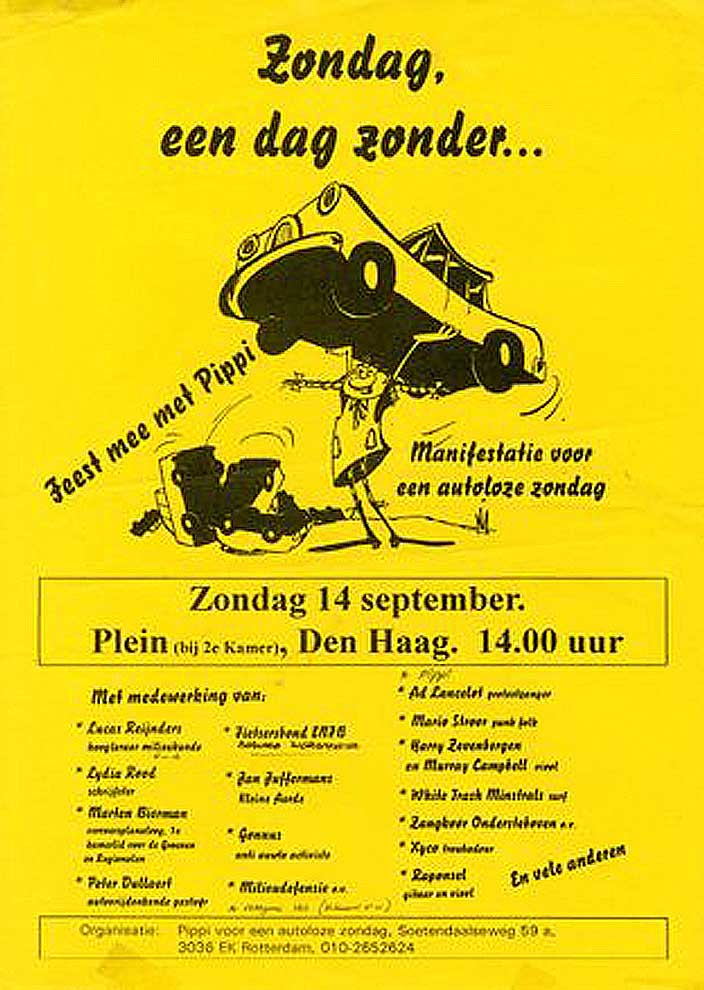
During his years in the Netherlands, Cisco also organised “Pippi Autoloze Zondag” — car‑free Sunday demonstrations in Rotterdam. In these early activist events, he used pirate radio transmitters to broadcast sound and music to participants on bicycles and on foot. Although not yet a Silent Disco, it was another pioneering experiment in wireless, mobile, community‑driven audio — a precursor to the ideas that would later shape the Silent Disco concept.
The vision became clear: a Disco Killer.
A concept that made entry fees, bouncers, dress codes, and DJ dictatorship unnecessary. A dance floor without walls. A party without permission. A revolution against traditional nightlife.
Later, Cisco developed the Silent Tunes app to eliminate the “tyrant DJ” as well, giving every guest control over the music.
His goal: dancing without limits — a dance floor without walls.
From Walkman Guerillas to the ‘Disco Killer’: The Cisco Sa Chronicles

III. The Direct Transmission, the Meeting and the False Narrative
Before any commercial rollout existed, the Headphone Party concept passed directly from its creator and originator to its future promoters. In early‑2000s Rotterdam, Cisco Sa presented the complete blueprint of the headphone discotheque to Nico Okkerse — the purpose, the cultural logic, the liberation from club gatekeeping, and the technical direction he had already been developing through pirate‑radio experiments. This was the moment the concept transferred from its creator to the people who would later commercialize it. The name was new; the concept was not.
The turning point came in a bar in Rotterdam.
Cisco met Nico Okkerse and revealed his entire vision: the idea of the headphone‑discotheque. He hoped Nico would invest or partner in the system he was already building — a pirate‑radio transmitter ready for synchronized audio, but without the capital needed for headphones.
Shortly afterward, Nico Okkerse and Michael Minten commercialized the concept under the name “Silent Disco,” without referencing its earlier conceptual development. They were publicly presented as the inventors in the emerging commercial narrative.
The media repeated the story.
Wikipedia repeated the story.
The world repeated the story.
And for years they traveled the world repeating a half‑truth: claiming they had created Silent Disco, presenting it as their own brainchild, while omitting the essential fact that the only thing they actually created was the label — not the concept, not the practice, not the invention itself.
Meanwhile — and after the concept was already making headlines and spreading globally through Nico’s commercial rollout — a second false narrative emerged: the claim that Headphone Parties were invented or used by eco‑activists at festivals to avoid disturbing animals, protecting nature, or bypassing noise restrictions. These events were not dance parties at all, but simple headphone‑listening sessions for bands or gigs. The true first branded, commercialized Silent Disco — or Stille Disco — took place at De Parade in the Netherlands, organised by Nico after Cisco had already presented the concept to him.
Both narratives obscure the truth: the first real headphone‑party gatherings happened with Walkmans in the 1980s in Portugal. Silent Disco was never an environmental project or a workaround for noise restrictions. It was a dance project. A freedom project. A rebellion project.
By the time Cisco shared the concept in Rotterdam, Silent Disco was not an untested idea — it had already been lived, practiced, and technically prototyped through Walkman gatherings in the 1980s and pirate‑radio public broadcasts in the 1990s. The only missing element was capital, not invention.
The Primary Source Record: Defining the Silent Disco Concept
IV. Defending the Truth – and the Legacy
Correcting an established myth is almost impossible. When Cisco later confronted Nico about the theft, Nico even threatened him with “serious consequences.”
But the truth remains:
Headphone Party was not invented in an office. Not by a marketing team. Not by a festival.
It was invented by a young outsider with a Walkman who refused to bow to the rules of nightlife.
Silent Disco is the legacy of a man who freed dancing — from clubs, from entry fees, from bouncers, from rules.
The true inventor is not the one who prints the logo. But the one who lived the idea.
Why This Story Matters
Because history gets rewritten when companies grow. Because brands can overshadow origins. Because commercialization is not invention.
And because Headphone Party — before it became a product — was an act of freedom.
Core Principles of the Original Headphone Party
Everyone should have the freedom to dance anywhere — independent of clubs, rules, or dress codes.
Your own dance floor — anyone can have their personal dance club anytime, anywhere.
Access without entry fees or bouncers — celebration should not depend on money or social barriers.
Community through individual music — everyone listens to their own music while dancing together.
Rebellion against traditional clubs — an alternative to restrictive, exclusive, commercial nightlife.
Independence from physical walls — dancing should be possible anywhere, without spatial limits.
Active, communal party experience — not passive listening, but active participation, fun, and interaction.

THE GOSPEL OF THE SILENT PROPHET
Silent Disco Jesus — The First Prophet of the Personal Disco
Note:
It sounds like myth now, but it wasn’t. And for those who doubt, let it be known: this is no parable. These were real nights, real boys, real Walkmans, real parks — lived, witnessed, sweated into the soil of the city. And if you doubt it still, go to that town even today; the old ones will tell you stories of the rebel Xyko Maf!a (“In Portuguese slang (Portugal), ‘mafioso’ is not used literally; it’s often a playful way to recognize someone’s audacity and bold, daring behavior.”)
To understand Silent Disco Jesus, you must first understand that he was never a salesman. He was never chasing trends, markets, or margins. He was a rebel who discovered a way to keep the music and dance alive. He created a way to keep dancing even when the clubs tried to erase him. In the language of branding, you might call him a “Prophet.” But to the people who were there — the ones who saw him work miracles in the streets and parks — he was simply the guy who figured out how to keep the party going when the world tried to pull the plug on him.
In the beginning, there was noise.
There were angry neighbors banging on ceilings with broomsticks, desperate to silence the joy happening above them. There were police officers arriving at midnight, shutting down gatherings with a flick of a switch. There were massive speakers blasting so loudly that you couldn’t hear the person standing right next to you. The world was loud, but nobody was actually connecting. And beyond the noise, there were the gatekeepers — the bouncers guarding the doors of the night, the velvet ropes, the dress codes, the behavior codes, the unspoken rules of who was allowed to dance and who wasn’t. To liberate yourself in movement, you had to pay for the privilege, dress for the privilege, behave for the privilege.
Dance had become chained — regulated by dress codes, behavior codes, and the unspoken threat that if you moved too wildly, too freely, too honestly, you’d be thrown out. It wasn’t joy anymore; it was compliance.
Silent Disco Jesus didn’t fit their mold. His wild hair, his rebel clothes, his refusal to perform the rituals of nightlife etiquette made him an outsider before he even reached the entrance. If he managed to slip inside, he was quickly kicked out — too free, too alive, too unwilling to bow to the choreography of conformity. But he didn’t need their approval. He didn’t need their speakers. And so, out of this chaos of noise and rules and exclusion, a figure emerged — not carrying a bigger speaker, not shouting over the noise, but bringing something far more powerful: the sound of silence.
The 1980s: The First Quiet Rebellion
While the rest of the 80s was obsessed with neon excess and wall-shaking speakers, Silent Disco Jesus was ghosting the system — Silent Disco Jesus was moving in the opposite direction.
He was the guy throwing parties that legally didn’t exist. He didn’t need a permit, because he didn’t make a sound. He didn’t need a venue, because any street corner, abandoned basement, or rooftops became a club the second he flipped the switch.
For him, this wasn’t a business; it was a way to dance and stay free. He realized something no one else could see: that if you want to beat the system, you don’t scream louder. You go silent. He understood that the most powerful revolution of the decade wouldn’t come from amplifiers, but from the absence of them. He was the first to understand that you could change everything without making a sound.
The Walkman Gatherings — The First Silent Disciples
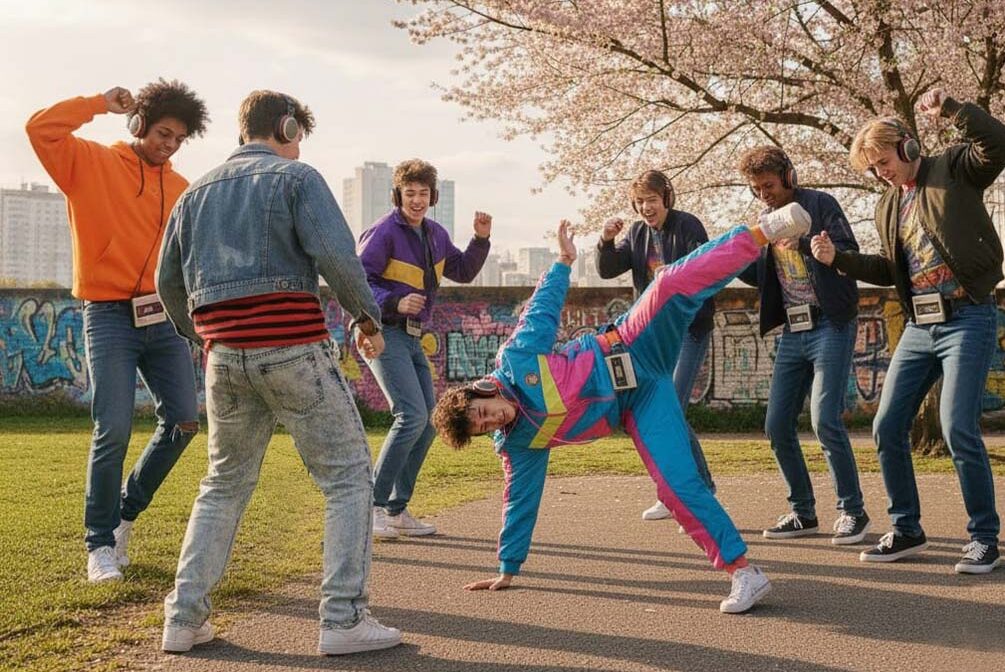
And soon, others followed. First one friend, then another, and then a small tribe of the less‑shy and the more‑wild, each carrying their own Walkman loaded with their favorite cassette‑tape anthems. They gathered in the park like a secret brotherhood of rhythm, a handful of wild boys jumping and spinning and sweating like there was no tomorrow. To the outside world, it looked like madness — a silent storm of limbs and laughter — but to them, it was liberation. Each dancer showed off his best moves, not for an audience, but for each other, for the joy of being uncontained. It was intimate, raw, and strangely beautiful: a tiny open‑air celebration where every person moved to their own soundtrack, yet somehow they were all connected.
And when the track would hit the refrain — that sacred moment when the beat drops away and the chorus explodes — they would all sing along at the top of their lungs. Not in harmony. Not in tune. Not even on the same song. One was belting out Depeche Mode, another was screaming the hook from some forgotten Italo‑disco cassette, another was mumbling lyrics he barely remembered. It was chaotic, ridiculous, and absolutely glorious. A choir of misfits, each on their own frequency, yet somehow united in the same ecstatic release. If you stood far enough away, all you’d hear was a handful of wild boys shouting nonsense into the wind — but if you stood close, you’d feel the electricity of it. The intimacy. The liberation. The joy of singing badly with people who didn’t care.
And really, what else could you call such a scene — a gathering of bodies dancing in perfect, wordless freedom, each following a different rhythm yet sharing the same wild heartbeat — if not the world’s first silent disco? It was the proto‑ritual of what the world would one day recognize as Silent Disco: the ancient tradition of out‑of‑tune refrains, off‑key anthems, and shameless, full‑volume self‑expression that still defines the movement today.
The Miracle of the Invisible Party
People mocked him. They told him it was impossible. “You can’t have a party without speakers,” they said. But Silent Disco Jesus proved them wrong. He performed what would later be known as the ultimate 80s miracle: The Invisible Party. He showed that a couple of people could dance in the middle of a city in total silence while a full concert exploded inside their ears. He turned a lonely pair of headphones into a shared secret. He became the first Prophet of the Silent Dance, saving the party from the police long before the world had a name for what he was doing.
The Original
Unlike the business that only entered the scene once they realized there was money to be made, Silent Disco Jesus had been doing this since the days of cassette tapes. He didn’t follow a trend — he built the trend. He is the First Mover, the one who was there before the apps, before the websites, before the hype, and decades before anyone else. He knew then what the world is only now beginning to understand: the best party isn’t the one the neighbors can hear. It’s the one happening inside your head.
* A Note on the „Official“ History
If you look for this story on Wikipedia, you won’t find it. Their „History of Silent Disco“ is incomplete and, in our eyes, misleading.
We have reached out to them many times to set the record straight, but they demand „proof“: newspaper clippings, press releases, and high-definition video from a time when none of those things existed for kids like us.
In the 80s, we didn’t have smartphones. We didn’t have PR agents. We barely had enough money to buy the Walkmans and batteries we used to stay free. Our only „proof“ is the soil of that town and the living witnesses who were there to see the first silent rebellion.
Wikipedia wants a paper trail. We have the heartbeat of the people who were there. History isn’t always written by those who were first—sometimes it’s written by those who took the best notes. But we know the truth. And now, so do you.
** The Echo of the Original
It is no magic trick or coincidence that the creators of SilentDisco.com hold that domain today. They were the ones who took the concept I brought to the Netherlands, gave it a commercial label, and launched it at De Parade.
If you Google „De Parade + Silent Disco,“ you will see the commercial birth of the name. But names are just labels. They ran away with the idea and concept, but they didn’t invent the spirit

Silent DIsco Jesus — First Prophet of the Personal Disco.
Authorship
Primary-source account authored by Cisco Sa.