Silent Disco History: The Origins of the Silent Party Concept
Born outside the system, hit by betrayal, and unleashed across the world — Silent Disco’s DNA is pure rebellion.
The accepted history of silent disco is a maze of copied timelines, recycled claims and borrowed origin stories. Sci-fi films, newspaper clippings and commercial launch narratives have been repeatedly conflated with actual lineage, obscuring the traceable developmental chain that led to the modern Silent Disco.
The origin becomes “hard to pinpoint” only when disconnected precedents are mistaken for a continuous history. Similarity is not influence. Precedence is not provenance. Resemblance is not lineage.
Turn up the silence
“The best party isn’t the one your neighbors can hear — it’s the one happening inside your head.”
THE NIGHT SILENT DISCO WAS HIJACKED
“He calls it his brainchild. So what was I — the anonymous donor who inseminated his brain and got erased from the birth certificate?”
Rotterdam, 2002 — Pub de Twijfelar
Silent discos grew from grassroots headphone dance practices in Europe in the early 1980s, developed through 1990s eco-activist car-free days, and entered commercial entertainment in 2002, when Cisco Sá pitched his “Headphone Discotheque” concept to Dutch promoters who later launched “Silent Disco” in the Netherlands. First came appropriation without credit, then deliberate erasure, followed by another distortion: science-fiction visions, technological experiments and unrelated dead ends were stitched into a supposed evolution toward modern Silent Disco. The result is a manufactured fog that obscures the true lineage and the actual path to the global format.
In 2002, the blueprint was already on the table. In 2010, I confronted the commercializer — the man who had presented the concept to the world as his own brainchild — and reminded him that I had delivered the complete blueprint directly to him and pitched the concept in 2002, seeking investment or a partnership. He first denied any such meeting ever took place. Weeks later, shown a photo, he recognized my face without explaining the contradiction. He warned me to stay out of “the danger zone.” And eventually, he settled into this:
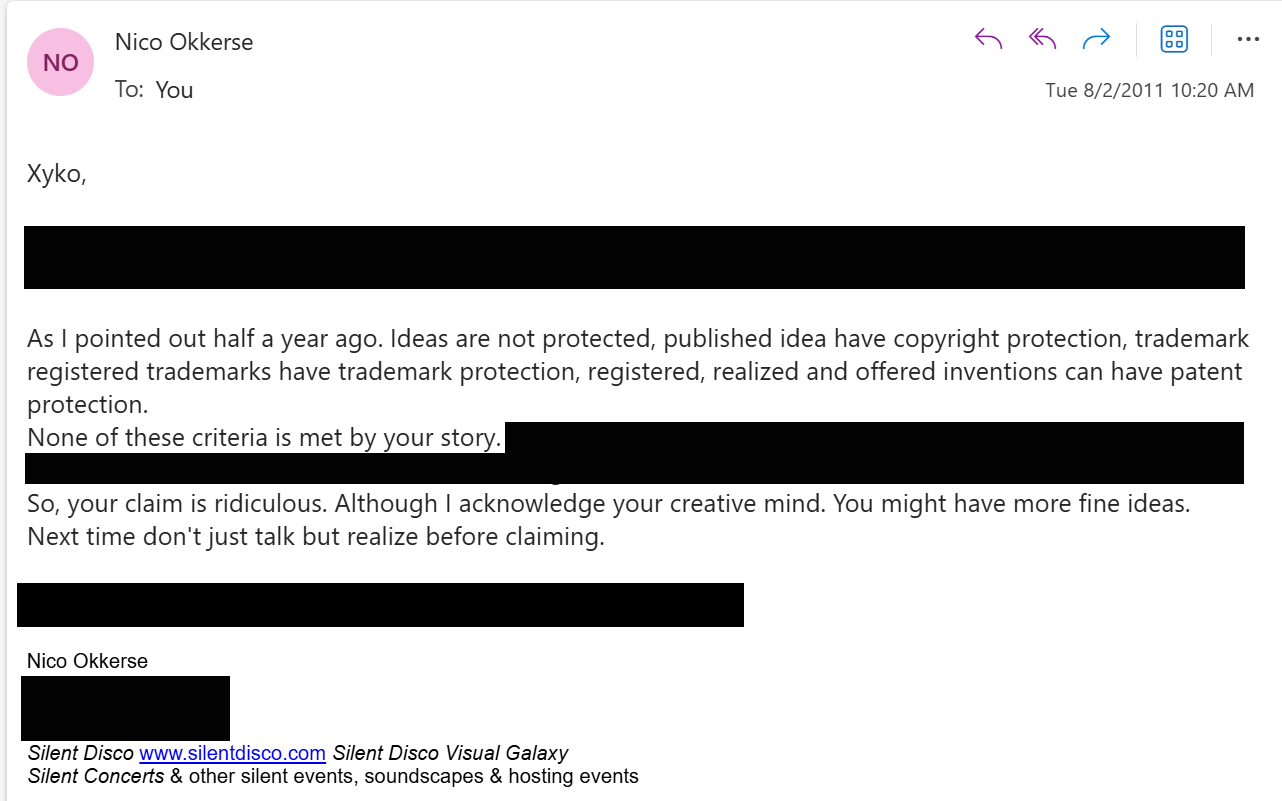
“Although I acknowledge your creative mind. You may have more fine ideas. Next time don’t just talk but realize before claiming.”
Telling me I should have realized it, not just talked about it, is rich — given that pitching the concept to him was the only reason he had anything to realize. Funny advice 🙂
Hijacked and erased is the conclusion I draw. The email exchange is reproduced at the bottom of this page. Draw yours.
The 2026 interviews and the documentary reconstruction are in my research paper.
Too Wild for the Clubs — Where Silent Disco Really Came From
By Cisco Sá — “Silent Disco Jesus”, researcher, author, and originator of the Headphone Party concept. Founder of SilentDisco.de and SilentDiscotheque.com, author of the 10 Silent Disco Commandments, and creator of the Silent Tunes app, where every farmer can be a DJ.
Explore the origins of the silent party concept, how it started and why it was created.
Introduction
So who actually invented Silent Disco? To answer that question, we need to separate the genuine lineage from the many ideas, experiments and narratives that have accumulated around it—and then examine how that lineage was subsequently obscured, appropriated and rewritten. The task is not simply to find a first occurrence, but to follow the thread that actually carried forward into the format that became the global Silent Disco.
Silent disco beginnings
He was turned away at the door, for dressing and behaving differently from what was expected. He was thrown out when he got in anyway, for dancing too wildly. So he built his own dance floor — with a Walkman, on a street in Portugal, in the early 1980s. This is the story of what that turned into, and who the world ended up crediting for it.
This article presents a primary-source account of Silent Disco history, drawing on firsthand experience, historical research, and documentary evidence to trace the concept from its origins in 1980s Portugal through its later commercialisation in the Netherlands.
Silent disco was a workaround for restrictions on partying, not a workaround for noise. The noise-fix story came later. The original problem was being denied the right to party — and finding a way to party anyway.
I was the one living it. Noise was the furthest thing from my mind. It never crossed my mind as a problem to solve. I was not trying to make a party quieter, satisfy the neighbours, or comply with the rules. On the contrary, I was thinking about how to break them — how to find a way to party when the usual doors were closed to me. The system was telling me I wasn’t allowed to party. My response was essentially: fck it, grab my beer.
That is why the later noise-solution narrative gets the origin backwards. Noise reduction became an important functional and commercial advantage of the format later, particularly as silent disco entered festivals, public events, and environments shaped by noise regulations. But that was not what drove the idea in the beginning. I did not think, How can I solve a noise problem?
At its core, silent disco was a vehicle for freedom: a way to take the party anywhere, anytime, beyond doors, walls and permission. That was its purpose from the first Walkman gathering through the investment pitch in 2002. What came later — the branding, the commercialization, the noise narrative, and the rewriting of who gets credit for it — changed what it was sold as, not what it was built to do.
There was never much to actually write about silent disco’s history, so the record filled up with whatever resembled it: a 1969 sci-fi film, a 1981 newspaper clipping, festival gigs that shared nothing but hardware. Wikipedia’s page is where much of that ended up, and media, academics, bloggers, industry and festival copy settled on Okkerse and Minten as the inventors. As far as I can find, none of them looked at the Rotterdam blueprint pitch, or at the chain that led to it, running from the 80s through the 90s into the 2000s. What follows isn’t a retelling. It’s that chain, traced.
Traditionalists write it off as too quiet to be a real party — no bass, can’t speak, blah blah blah. Wait until they find out it was created for true wild rebels.
The idea, lived
Headphone Party did not begin as a brand, a logo or a product. It was an escape: a way to dance without clubs and without rules. It was lived long before anyone had a name for it.
In the early 1980s, shortly after the Sony Walkman appeared, music became portable, personal and boundless. For Cisco Sá, then a young outsider in Portugal known in his hometown as “Xyko Maf!a”, it was more than a gadget. Nightlife was full of barriers: dress codes, arrogant bouncers, entry fees, and the feeling of not fitting the system. If you didn’t look the part, you didn’t get in. If you danced too wildly, you were thrown out. He was once even excluded from a “wildest dancer in town” competition for being too wild.
So he made his own dance floor. Walkman on his belt, headphones on, he danced alone, first in the street, then in parks, then with friends who brought their own Walkmans and cassettes. Everyone listened to their own music. Everyone danced in their own world. And yet they were together. It wasn’t called Silent Disco. It was simply freedom.
The world it happened in
Portugal in the early 1980s was fresh out of the authoritarian period: the Estado Novo dictatorship had only fallen in 1974, and the mentality it left behind was still conservative and traditional, still carrying the residue of decades of closed, controlled public life. Public space was socially judged and controlled — you couldn’t step much out of line without someone noticing and saying so. Dancing belonged inside clubs, under the control of speakers, DJs and bouncers, and there were strict, unwritten expectations about how you looked and behaved before you were let onto a floor. The Walkman, when it arrived, felt almost futuristic — a tiny machine that meant one thing: privacy, a “Do Not Disturb” sign carried at the ear, in a country not used to that kind of personal freedom. The Walkman was built for exactly that kind of solo listening everywhere in the world — one person, one soundtrack, alone in your own head. Portugal was no different. What made the park gatherings strange wasn’t the device. It was taking something built for solitude and doing it together, out loud, in a country not used to that kind of freedom in public. Now picture a few kids in a quiet park, each lost in a different cassette, dancing together with no speakers, no sound, no permission. In a country only a few years removed from authoritarian control, it looked like a glitch in reality. It was radical.
Silent disco origins, step by step
- 1980s, Portugal. Walkman gatherings in streets and parks. Chaotic, liberating, and already a dance practice, not a listening session.
- September 1985. Cisco leaves Portugal. About ten years as a nomad across Europe, without money or papers, in squats, with repeated deportations. He calls it his “wild vagabond PhD.”
- 1990s, Netherlands. The old idea returns with new technology. He organises “Pippi Autoloze Zondag”, car-free Sunday demonstrations in Rotterdam, and uses pirate radio transmitters to broadcast music to people on bicycles and on foot. Not yet a Silent Disco, but wireless, mobile, community audio. The vision has a name: the Disco Killer.
- 2002, Rotterdam. Cisco pitches the full “Headphone Discotheque” blueprint, as an investment proposal, directly to Nico Okkerse — the man who would launch “Silent Disco” months later — in the bar De Twijfelaar: the purpose, the liberation from club gatekeeping, the technical direction. He has a pirate-radio transmitter ready for synchronized audio and no capital for headphones. He hopes Nico will invest or partner. He declines.
- Months later. Okkerse and Michael Minten launch “Stille Disco” at De Parade in the Netherlands, without agreement and without crediting the earlier concept. They are presented as its inventors. The media repeat it. Wikipedia repeats it.
- December 2010. When Cisco raised the matter with Nico, he warned him to “stay out of the danger zone.”
- February 2011. In a subsequent message, Nico wrote:
“I appreciate you stop spreading your story… if you continue I will cause you trouble.”
Cisco understood this as a warning to stop telling his story or face consequences.
The lazy history of silent disco
Precedence is not provenance. Plenty of people pictured this idea before Cisco lived it. That distinction is where the accepted history goes wrong, and it’s worth being precise about before going further.
There is a difference between “this is documented” and “this is true.” What gets published as the history of silent disco is closer to Wikipedia dressed up as research: a claim doesn’t need to be true, only to already look cited. Buried under the repetition is one specific question, who invented this format and where the idea came from, and nobody actually checked it. People passed it along, treating “I read it somewhere” as “I confirmed it.”
What a reader sees at first glance is the problem. A list of scattered, resembling events — a film, a clipping, a festival gig, an activist action — reads as a shrug: too many candidates, no way to tell, must be “various influences.” That first impression is exactly backward. Underneath it, only one line in that list is actually checkable against dates, witnesses and correspondence, and everything else in it is a dead end the moment you ask whether it led anywhere. The surface hides the answer by making it look like there isn’t one.
The mechanism: citogenesis
Wikipedia editors have a word for it. Someone writes a claim with no real backing. A journalist on deadline lifts it because it is already formatted like a fact. Now the claim has a citation. The next writer cites the journalist, and the page is updated to cite the journalist as confirmation of what the journalist got from the page. The loop closes and nobody ever touched the ground.
A smaller, checkable version of the same thing happened with geography, not just authorship. Wikipedia’s own account of silent disco leans heavily on Bonnaroo Music Festival’s 2005 event as a milestone, and from there some reporters went further, writing up silent disco as a trend that travelled from America to Europe. The dates run the other way. De Parade launched the term “Silent Disco” in the Netherlands in 2002. Bonnaroo picked it up three years later, in 2005, introducing an already-existing European format to a US festival crowd. Nothing about that sequence supports an America-to-Europe story, but once a Wikipedia-style timeline puts Bonnaroo in a prominent early slot, the flow of the story reads that way anyway, and gets repeated as background fact. It’s the same citogenesis mechanism as the authorship claim, just applied to place instead of person.
That is how a 1969 Finnish sci-fi film, a 1981 newspaper item, a Chicago gallery installation, a BBC gig, and a festival crowd watching football on headsets all end up in one “evolution of silent disco” timeline. They don’t share a story. They share a search result.
The test nobody applied
Only one question separates a real source from a coincidence: did it influence what came next? Not does it resemble it. Not does it use similar words. Influence, a line you can trace.
Precedence asks whether something like this existed earlier. Provenance asks where this particular thing came from. A pile of precedents never adds up to provenance. It only shows the idea was in the air, which nobody disputed.
The Vikings reached North America five hundred years before Columbus, and there is an archaeological site to prove it. Nobody credits Leif Erikson with discovering America, because his landing led nowhere: no sustained contact, no next voyage, no chain running forward. Columbus gets the credit because his voyage connected to everything after it. Precedence went to Erikson. Provenance went to Columbus.
The candidates, tested
“Various influences contributed to its emergence” is the line most write-ups reach for instead of answering the question. It sounds careful. It is actually a way of not checking. The only question that matters for each candidate below: did this lead to what happened in Rotterdam in 2002, or did someone simply notice a resemblance to it afterward? Dates and evidence quality are stated plainly, including where the record is still thinner than it should be.
| Date | Candidate | What it shows |
|---|---|---|
| 1920 | Atlanta social club, radiophone dance | Real experiment with dancing to transmitted music through earphones. No documented continuation. Dead end. |
| 1928 | William Heath Robinson illustration | Fictional drawing of private dancing to radio through headphones. Dead end. |
| 1968 | Osamu Tezuka, Astro Boy | Fictional anticipation. No documented transmission. Dead end. |
| 1969 | Ruusujen aika (Time of the Roses) | Fictional headphone nightclub. One-off depiction. Dead end. |
| 1981 | The Age, “Headphone versatility” | Remarkably early use of the phrase “silent disco”. No documented continuation into 2002. Terminological precedent, dead end. |
| 1982–85 | Walkman gatherings, Portugal | Real, realised practice. Currently supported mainly by firsthand testimony. Start of the lineage. |
| 1990s | Car-free Sundays with pirate radio, Rotterdam | The activism is press-documented (Trouw, Ravage). The pirate-radio-for-music detail rests mainly on firsthand recollection. Developmental lineage. |
| 1990s | Eco-activist headphone gatherings | Isolated, one-off events. No documented influence on 2002. Dead end. |
| 1994 | Glastonbury football broadcast | Public viewing on headsets, not a dance practice. Dead end. |
| 2000 | BBC gig | Headphones at a live event. A gig is not a disco. Dead end. |
| 1990s–2000s | Chicago gallery installation, art events | Independent artistic experiments, no documented link to 2002. Dead end. |
| 2002 | Pitch to Nico Okkerse (the commercializer) | Experience and technical development become a defined commercial proposition. Cisco Sá presents the Headphone Discotheque blueprint in person as a concrete investment proposal. Lineage. |
| 2002 | De Parade | First commercial “Silent Disco”, months after the pitch. Commercial launch. |
| Mid-2000s | Flash mobs | Downstream of 2002; cannot have influenced it. |
| After 2002 | Commercial industry | Wireless systems, festivals, international adoption. Continuation. |
The existence of an earlier example establishes chronological precedence; it does not, by itself, establish a connection to the 2002 format. Establishing a historical lineage requires evidence of transmission, continuity, or developmental influence linking the earlier example to the later one. In the cases discussed here, no such connection has been demonstrated between the separate earlier examples themselves or between those examples and the 2002 development: they appear in the record as independent, isolated occurrences, with no documented contact, transmission, influence, or continuing development linking one to another. Nor do they presently constitute separate parallel lineages converging on the 2002 format; the evidence shows one-off experiments, fictional anticipations, or isolated applications rather than sustained developmental paths. Placing them together in a single chronological list can therefore create the appearance of an evolutionary chain — or of multiple parallel lines — that the evidence does not establish. On the evidence currently available, these examples remain precedents rather than demonstrated ancestors. Among the known antecedents, the Cisco Sá sequence is the earliest currently documented lineage that can be traced continuously into the 2002 commercial format.
Of the fifteen rows above, only three are part of an actual lineage rather than a tested-and-eliminated candidate: the Walkman gatherings, the Rotterdam car-free-Sunday pirate-radio actions, and the blueprint pitched as an investment proposal. Everything else on the list, going back over a century, falls into one of two categories. Some are real, executed events that simply didn’t lead anywhere — documented dead ends on their own terms, with nothing running forward from them. Others were never executed at all: the Astro Boy episode, the Heath Robinson illustration, the 1969 film, the 1981 newspaper hypothetical — fiction and imagination, not practice. Nobody danced, nobody built anything from them, and nobody downstream was influenced by them; they were simply noticed, decades later, by researchers searching backward for anything that looked similar. Neither category is part of the commercial branch that followed once the pitch had already happened (De Parade, and the industry after it). That’s ten separate eliminations among the precedent candidates alone, each on its own evidence, not ten assumed together. Once each one is individually ruled out as a source, they don’t add back up into one when you pile them in the same paragraph.
That pile-up is exactly what “various influences contributed” is doing. It doesn’t claim any one of these things caused the 2002 launch, because none of them can survive that claim on its own. It substitutes a crowd for a chain: enough resemblance, listed together, starts to feel like an explanation even though not one item in the list individually explains anything. Five people independently having a similar dream doesn’t mean five people collaborated on a film. Adding zero influence six times is still zero influence. The only candidate that changes when you ask the direct question — did this actually lead to what launched in 2002 — is the one that ends in a named bar, a named date, and a second person confirming the meeting happened.
A list of things that happened before is a history of precedence. A chain showing what developed into what is a history of provenance. This page is about the difference.
Imagined versus lived
The 1981 clipping is the best-disguised look-alike, and it fails by its own wording. It does not report an event. Nobody credits Les Cardilini or The Age with inventing silent disco, even though the phrase sits there in black and white twenty-one years before the commercial launch. If a dated, phrase-exact clipping doesn’t earn the title, nothing weaker does.
Da Vinci sketched a screw-type flying machine in the 1480s. It was never built, tested or flown, and no engineering line runs from it to Sikorsky’s helicopters. Nobody calls Da Vinci the inventor of the helicopter. It is a picture of an invention. The clipping and the sci-fi scene are the same kind of object.
Test the standard against a stronger case. Motorola engineers have credited Star Trek’s communicator with shaping the StarTAC flip phone: named engineers, a specific design feature, decades of citation. Even so, nobody credits Gene Roddenberry with inventing the mobile phone. Documented influence is one contributor to a lineage, not the origin. Time of Roses does not come close to that standard.
Now the difference. In the early 1980s, on the other side of the planet from those clippings, Cisco Sá was doing it, with a Walkman, dancing with friends in a park in Portugal. From there into the synchronized pirate-radio street actions of Rotterdam’s car-free activism in the 1990s, into a fully worked-out Headphone Discotheque concept, into a pitch with actual terms made directly to an actual promoter, months before that promoter’s launch. Each stage feeds the next. If it had stopped at a few friends in a park, it would sit in the same pile as the clipping. It didn’t stop there. Aggregation can’t see that difference because it only checks whether the phrase shows up. It never asks what happened next.
The noise-fix reflex
The most repeated explanation is that silent disco exists to solve noise: curfews, complaints, ordinances, angry neighbours. It is baked into permit applications and trade copy, repeated because it is convenient, not because anyone traced it to a motive. Noise was the surface, not the cause. A Walkman on a street in Portugal in the early 1980s wasn’t quiet because of a noise ordinance. It was quiet because it was private, because it needed no venue, no bouncer, no owner’s sign-off. The point was autonomy, not compliance. Silent Disco was never an environmental project or a workaround for noise restrictions. It was a dance project, a freedom project, a rebellion project.
The idea was never about reducing sound. It was about reducing permission. Why should dancing depend on a club, an owner, an entry fee or a wall? A Walkman on a belt asked a simple question: why should music be something that happens to you, rather than something you choose, wherever you happen to be standing? Even where the format is described today as a fix for noise rules, the underlying purpose hasn’t changed: keeping the dance alive somewhere nobody else gets to shut it down. Noise is the surface. Freedom is the core.
The same facts, four ways
Look at the record through different lenses and the pattern holds up. It’s the same events, described from four angles at once.
| Lens | What actually happened | What the commercial story says |
|---|---|---|
| Core innovation | Collective dancing via personal audio, in a Portuguese park | “Silent Disco” as a branded event format |
| Primary motivation | Escape from exclusion and gatekeepers | Solving noise complaints and festival permits |
| Origin form | Informal 1980s Walkman gatherings, developed through 1990s pirate radio | A 2002 festival deployment (De Parade) |
| Meaning of “silent” | A side effect of dancer autonomy | A marketing hook and selling point |
Practice preceded product in every row. What changed at commercialization wasn’t the idea — it was who got credited for having it.
Diluted, and in places replaced
When researchers stacked up the look-alikes, they didn’t confirm the commercializers’ “brainchild” story. They quietly wrecked it. Their claim was never only “we launched this commercially.” It was “we thought of this, from nothing, first.” With a dated 1981 item and a sci-fi scene on record, “first” stops being defensible, and the story shrinks to “first to sell it.” That alone is dilution. In a growing number of accounts it goes further: the fog line replaces the origin question outright, and Okkerse and Minten aren’t named as inventors at all, just as the people who threw the first commercial event somewhere inside a story that supposedly has no single starting point. Either way, nobody else inherits the title, because none of those precursors influenced anything downstream. The field settles into an equilibrium where the commercializers’ sole-originator claim is weakened or dropped, and everything else in the pile is still too disconnected to replace it with a name.
That equilibrium has its own citation loop, and by now it is the more common one. “Pinpointing the exact origin of silent discos is tricky, with various influences contributing to their emergence” — or some close paraphrase of it — turns up more often in blogs, festival copy, and even academic write-ups today than the flat claim that Okkerse and Minten invented it outright, and in some of those pieces it has simply taken that claim’s place. It sounds like caution. It functions the same way citogenesis always does: nobody who writes that sentence checked whether any of those “various influences” connects to anything, because the last several writers who used the line didn’t check either. The difference is that this hedge has no name attached to it, which makes it harder to argue with than a claim someone could be asked to prove. A vague fog of contributors is not more true than a single false claim, and it isn’t more true than the one line in this fog that is actually checkable. It is just a claim nobody has to defend.
What this claims, and what it doesn’t
This is not a claim that Cisco Sá was the first human being to imagine people dancing with headphones. It is not a claim that the 1981 clipping, the sci-fi scene, the festival events or the football broadcasts are fake. They are real and part of the wider prehistory. It is not a claim that the commercializers contributed nothing: naming an event, booking a venue and putting it in front of a paying crowd are real acts, and they are theirs. And it is not a claim that resemblance equals proof. Nor does any of this prove, by itself, that every earlier precedent is irrelevant, or that this account is established beyond dispute — a chain is stronger evidence than a list, not a verdict.
The Walkman gatherings matter not simply because they may be among the earliest real examples of what would later be called a silent disco. Their importance lies in what happened afterward. Unlike the other precedents on the table above, which appear in the record as isolated events, the Portuguese gatherings are the start of a continuous development: from collective Walkman dancing, through synchronized pirate-radio experiments in Rotterdam in the 1990s, to a formal Headphone Discotheque concept and its presentation to a future commercializer in 2002. The question is therefore not simply who danced with headphones first. It is which of the known precedents has a documented line running forward to the 2002 commercial launch. The claim on this page is the second, narrower one: not “nobody else ever did anything similar,” but “among the known precedents, this is the one with a traceable developmental line into what launched in 2002.” That is a more defensible proposition than declaring a winner outright, and it does the same work — it just doesn’t claim more than the evidence supports.
It is a claim about transmission: what the man who received the pitch knew, when he knew it, and what happened immediately afterward. That is narrower than “he invented nothing,” and stronger, because it needs only one meeting to be real.
What actually influenced the commercializers
Here is the sequence, stated plainly. Cisco Sá had already built and run the format in an earlier form in Portugal and then in Rotterdam. He presented a fully worked concept, not a sketch or a resemblance, directly to Okkerse as an investment proposal. Okkerse declined to invest. Months later the commercializers launched the same format under a new name, without an agreement and without credit to the person who had pitched it. In the two decades since, the public version of events has not included that meeting.
Each of those is a factual proposition. The pitch happened, or it didn’t. The launch followed it, or it didn’t. Credit was given, or it wasn’t. If that sequence is accurate, the story doesn’t need a new villain. It needs a new author. The accepted history has always answered “who launched this commercially” correctly. It never asked “who supplied the concept.”
The asymmetry that made it possible
The commercializers had no public rival when they named their event. The Rotterdam pitch was a private conversation, not a competing public claim. That absence of pushback let their version harden into settled fact before anyone thought to check it. Once a claim sits unchallenged and citable for years, every writer after inherits it as background knowledge. Repeating it stays cheaper than checking it.
So the honest shape of this history: silent disco did not descend from sci-fi, from flash mobs, from a BBC gig or a football broadcast, from the eco-activist gatherings, or from the Chicago art events. All of it is precedent in the loosest sense: things that happened once and led nowhere. It descended from one line: Portugal, to Rotterdam, to a pitch that was heard and not funded, and then a launch.
Not parallel invention
One objection deserves a direct answer, because it’s the obvious one: couldn’t this simply be parallel invention — two people, in the same city, arriving independently at the same unconventional idea, around the same time? Independent invention happens elsewhere in history, so it’s a fair question before accepting a transmission story instead.
But parallel invention describes two people reaching an idea with no contact between them. That isn’t what’s being described here. There is a documented, in-person meeting: a specific pitch, at a named bar, on a specific occasion, with a second person’s account confirming it happened. Once that meeting is on the table, “maybe they each thought of it separately” isn’t a competing explanation for what came next — it’s an alternative that only works if the meeting is set aside.
There’s a second problem with reaching for “the idea was in the air” as an explanation. That reading is only available in hindsight, now that silent disco exists and looks inevitable. At the time, the concept wasn’t received as obvious — it was received as absurd. People he described it to reacted with open disbelief: too crazy, not something you could actually do, get out of here. An idea that provokes that reaction from the people it’s pitched to isn’t sitting in the cultural water supply waiting for two people to fish it out separately. Two people converging on it independently, in the same city, in the same year, would be the coincidence that actually needs explaining — and there’s a simpler explanation already sitting in the record.
So who really originated silent disco?
Search today and the answer is consistent: the Dutch DJs Nico Okkerse and Michael Minten, who have described it as their brainchild. That claim has been repeated until it hardened into accepted history.
But I was there. I was in the room with Okkerse. I delivered the concept to him directly, the blueprint of what I had already developed. I remember exactly what I was afraid of: that I had handed the idea to someone with the means to take it, build it, and leave me out of it.
That is not a claim about what was in his head. It is a claim about what happened next. The meeting happened. The concept was presented. The investment was declined. Months later the commercial version appeared. Were the Dutch the first to put something called a Silent Disco on a commercial stage? Yes. The question is whether they originated the concept they claimed as their brainchild.
Because history gets rewritten when companies grow, brands overshadow origins, and commercialization is not invention. The true inventor is not the one who prints the logo, but the one who lived the idea.
The original principles
- Freedom to dance anywhere, independent of clubs, rules or dress codes.
- Your own dance floor, anytime, anywhere.
- No entry fees, no bouncers. Celebration shouldn’t depend on money or social barriers.
- Community through individual music. Everyone hears their own music while dancing together.
- Rebellion against restrictive, exclusive, commercial nightlife.
- Independence from physical walls.
- Active, communal experience, not passive listening.
Evidence on record: silent disco origins, documented
Quick facts
- Who first practiced the concept? Cisco Sá, dancing with a Walkman and friends in Portugal in the early 1980s.
- When did it start? As a lived practice, 1982–1985, shortly after the Walkman reached Europe. As a full, presentable concept, by 2002 in Rotterdam.
- Where did it start? Portugal, developed further through pirate-radio work in the Netherlands in the 1990s, then pitched directly to the man who commercialized it in 2002.
- Who commercialized it, and when? Nico Okkerse and Michael Minten, branding it “Silent Disco” and launching it publicly at De Parade in 2002, months after the pitch.
- Was it built to solve noise? No — see “The noise-fix reflex” above. That framing was attached later, by festivals and hardware vendors who needed an easy pitch for venues and permits.
- Which came first, the practice or the name? The practice, by roughly two decades.
As a factual reconstruction, the claim rests on more than memory. Some of it is independently checkable.
- Public activism record, 1997–98. The Dutch press archive Trouw and the activist registry Ravage independently document the “Pippi Autoloze Zondag” car-free-Sunday actions and name Cisco Sá as lead organiser, establishing the public context for the pirate-radio synchronisation work that fed into the 2002 pitch.
- The Walkman timeline. Sony’s TPS-L2 was released in Japan in mid-1979 and did not reach continental European retail until 1980–81, which is checkable against any account that places a European Walkman earlier than that.
- Independent corroboration. Michael Minten, Nico Okkerse’s former collaborator, independently confirmed the Rotterdam conversation took place: “I know the conversation between Nico and Cisco took place.” He placed it within discussions already underway about wireless headphone use for art installations and performances — not yet a dance format — situating the meeting within the developmental chronology that preceded Silent Disco’s commercial emergence.
- A colleague’s assessment. Polstra, a DJ who joined the Silent Disco operation roughly a year after launch and worked closely with the team in its early years, said he didn’t believe Okkerse had independently conceived the full concept: “I’m sure Nico didn’t suddenly jump from theatre straight to a full Silent Disco concept.” Asked to guess where such an idea might have come from within the team, he pointed to Minten, not Okkerse, as more likely — by his own account, a guess, not a claim of knowledge.
- Correspondence on file, 2010–2011. A documented email exchange exists between Cisco Sá and Nico Okkerse, beginning when Okkerse was asked directly about the Rotterdam meeting. Quoted below in sequence.
- A fuller account — including 2026 interviews, additional contradictions, and admissions not covered here — is laid out in the full academic reconstruction:Silent Disco History and Origins, SSRN.
The correspondence, in order
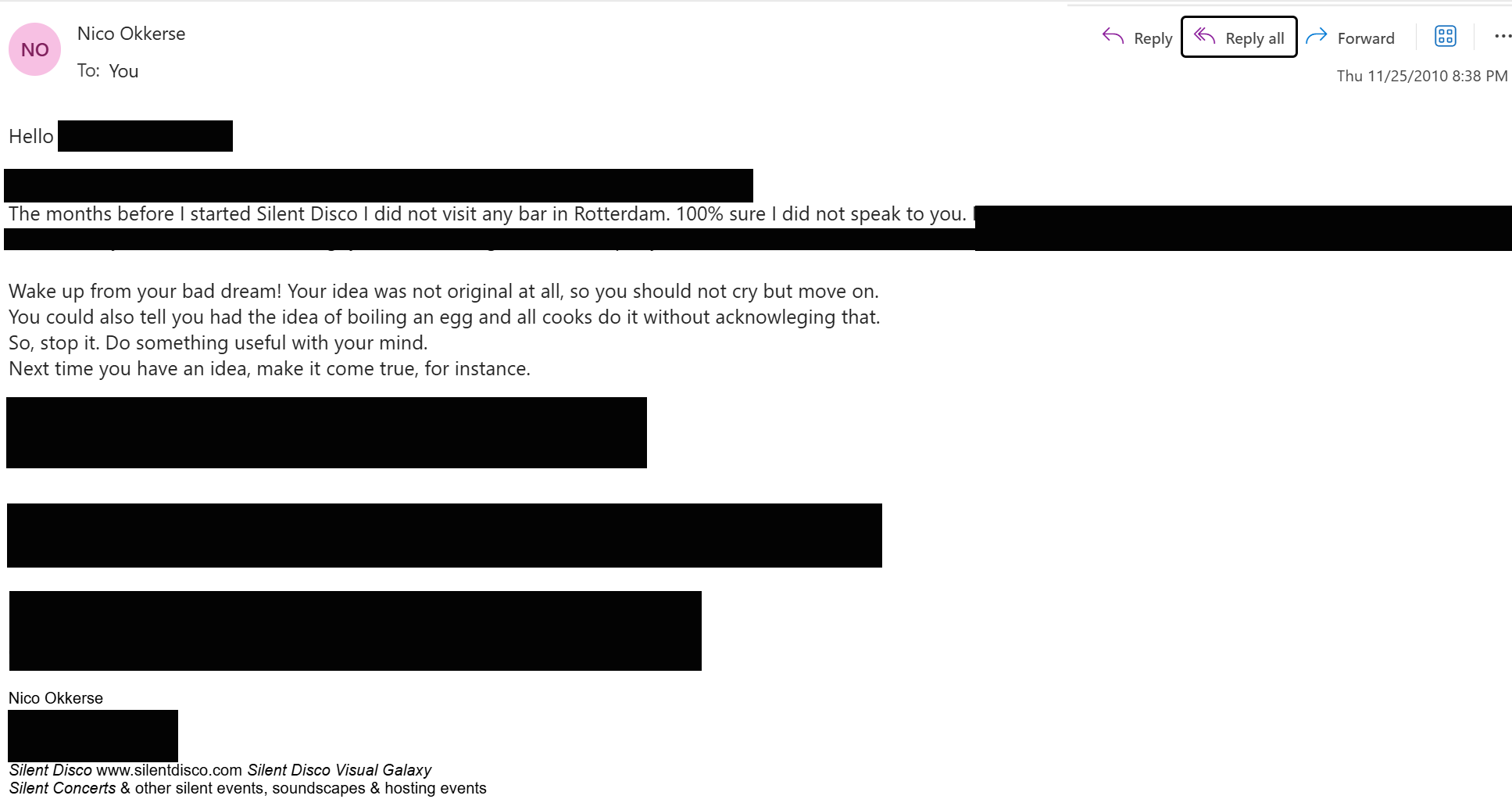
- 25 Nov 2010, 20:38. “The months before I started Silent Disco I did not visit any bar in Rotterdam. 100% sure I did not speak to you.” … “Wake up from your bad dream! Your idea was not original at all.”
- 22 Dec 2010, 11:01. “Also be aware that using Silent Disco as title will make you a thief of my copyright.” … “Ideas are not protected… for me, realizing is the start of building legal protection.”
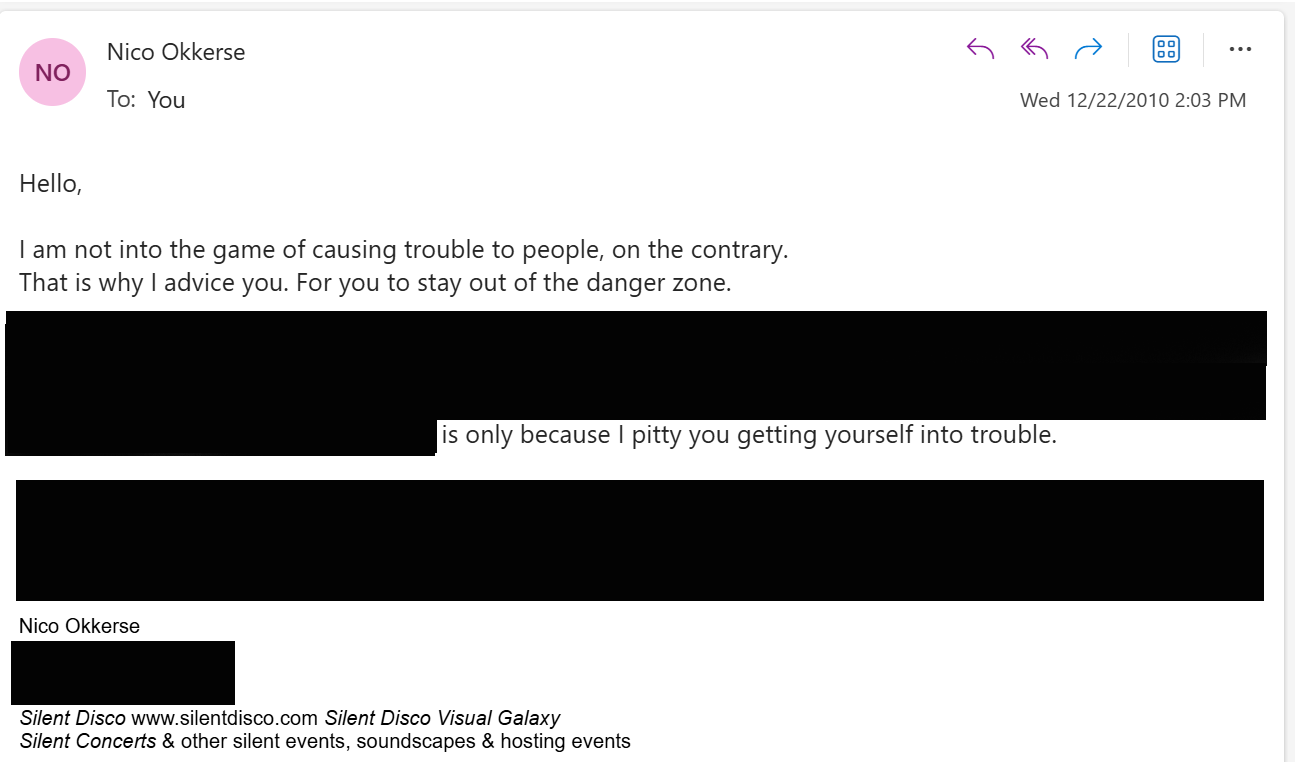
- 22 Dec 2010, 14:03. “I am not into the game of causing trouble to people, on the contrary. That is why I advise you, for you to stay out of the danger zone… only because I pity you getting yourself into trouble.”
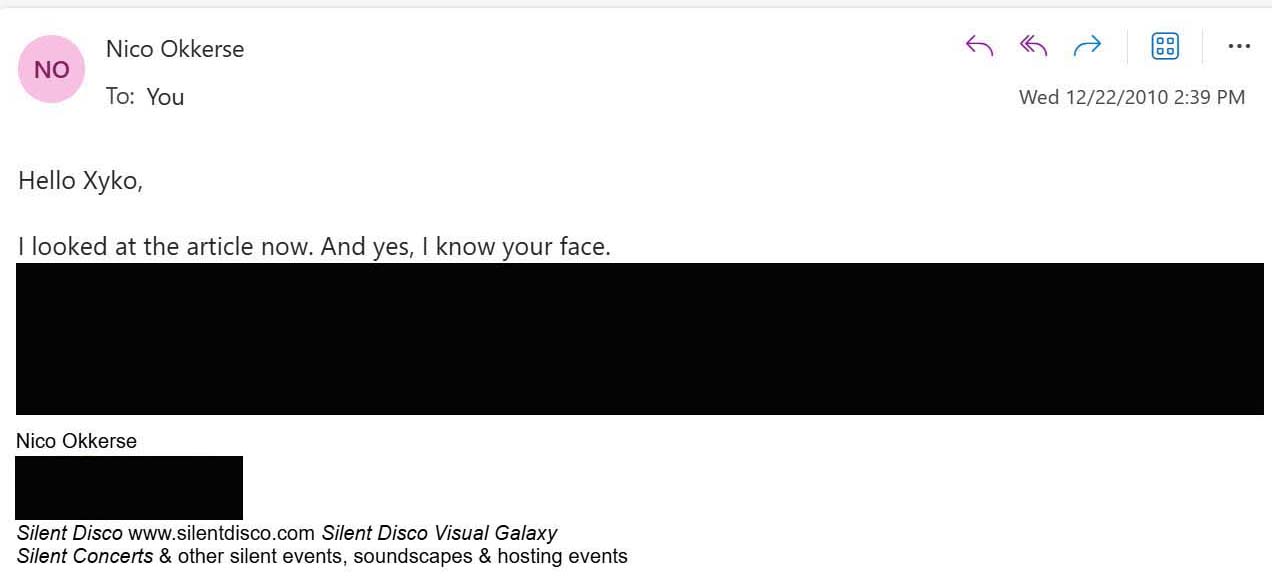
- 22 Dec 2010, 14:39. “I looked at the article now. And yes, I know your face.”
- 2 Aug 2011, 08:41. “I would appreciate if you would stop spreading your lies… If you continue I will cause you trouble.”
- 2 Aug 2011, 10:20. “None of these criteria is met by your story… your claim is ridiculous. Although I acknowledge your creative mind… leave me out of your present business. I am fine by myself.”
Read start to finish, the position moves from an absolute denial that any meeting took place, to recognising the person in question three weeks later, to a legal argument about ideas versus realisation — without the initial denial ever being repeated or explained.
“An idea isn’t enough” — true, and beside the point
Okkerse’s own defense, in the correspondence, is a real legal principle: an idea alone isn’t protected; realizing it is. Taken on its own, that’s a fair point. Millions of people have had the thought “wouldn’t it be interesting if…” and never built anything from it. Having an idea and being the originator of something aren’t automatically the same claim.
But that principle answers a question nobody is asking. The question isn’t whether an unformed idea, mentioned in passing, deserves credit for what someone else built. It’s where a specific, fully-worked concept came from — one detailed enough to pitch as an investment, with a technical plan (a pirate-radio transmitter ready for synchronized audio) and a lived practice behind it. That’s not a stray thought thrown out in a bar. It’s the kind of pitch that either lands or doesn’t, and there’s a way to check which one happened here: what Okkerse did afterward. He didn’t dismiss it, or forget it, or need it explained twice. He declined to do it, and months later launched the same format under his own name and label.
That sequence only makes sense if the pitch actually worked — if it was strong enough to recognize as something worth building. An idea that wasn’t compelling doesn’t get built by the person who heard it three months later. So “having an idea isn’t enough” cuts the wrong way here: the very fact that Okkerse moved on it that fast is evidence the idea was substantial, not evidence it was disposable.
What happened after that is a separate question from whether the idea was real, and it’s the one the correspondence actually answers: not a shared credit, not an acknowledged influence, but an account that moved from flat denial the meeting ever happened, to recognizing the person in the photo three weeks later, to a legal argument about ideas versus realization, to warnings to stop talking about it. That progression isn’t what someone does when a claim is baseless. It’s closer to what the record would look like if it wasn’t.
Timeline
| Phase | Dates | What happened |
|---|---|---|
| Conceptual origin | 1982–1985 | Walkman group dancing, Moita, Portugal — possibly the earliest lived practice of collective headphone dancing, and the earliest with a traceable line to 2002 |
| Development | 1995–1998 | Pirate-radio broadcasting to synchronised crowds during car-free-Sunday actions, Rotterdam |
| Full concept formed | 1997–2001 | Walkman-era practice and wireless broadcasting formalised into a complete “Headphone Discotheque” concept |
| Direct pitch to the future commercializers | 2002 | Full blueprint pitched in person, as an investment proposal, to Nico Okkerse — the man who would launch “Silent Disco” months later — in a Rotterdam bar (De Twijfelaar) |
| Commercial launch | 2002 | “Silent Disco” launched publicly at De Parade festival, months later, under a new name |
| Festival adoption | 2003–2005 | The format standardises across European festivals following De Parade; Bonnaroo 2005 is its U.S. debut, three years later, adopting a term already in use in the Netherlands — not the origin point some accounts later made it out to be |
| Noise-narrative attaches | 2005–2010 | Festivals and hardware vendors begin framing the format as a noise-complaint fix — a story about adoption, not origin |
| First confrontation | 2010–2011 | Direct correspondence with Okkerse: denial, then recognition, then a legal argument, then warnings — quoted above |
| Wikipedia canonisation | ~2010–present | The commercial-launch narrative becomes the default cited history |
| Precedent fog assembled | ~2005–present | Researchers and writers compile disconnected precursors — the 1969 film, the 1981 clipping, festival broadcasts, eco-activist gatherings — into one “evolution” narrative. This dilutes the commercializers’ sole-inventor claim, and in a growing number of accounts replaces it outright, without crediting anyone in its place: enough scattered resemblance makes a single originator look uncheckable rather than findable |
The Gospel of the Silent Prophet
Silent Disco Jesus, the first prophet of the personal disco
It sounds like myth now, but it wasn’t. These were real nights, real boys, real Walkmans, real parks. Go to that town even today and the old ones will tell you of the rebel Xyko Maf!a. (In Portuguese slang, “mafioso” isn’t literal. It is a playful nod to someone’s audacity.)
He couldn’t get into the clubs he wanted to party in. So he found another way. With a Walkman on his belt and headphones on his ears, he took the party outside — onto the street, into the parks, anywhere the club door couldn’t reach.
He wanted to party. That was the whole point. Dancing was just the visible part of it. The party was the rebellion.
The clubs had doors, bouncers, dress codes and rules about who belonged inside. If they said no, the night was supposed to be over. If they let him in and decided he was too wild, they could throw him out. The message was simple: you don’t get to party here. So he found a way to party without them.
The Walkman made it possible. He could carry his music with him, leave the speakers behind, and take the party wherever he wanted. The club could control its own room. It couldn’t control the street. Then friends began bringing their own Walkmans and cassettes. One person became several. The music could be different in every pair of headphones, but the party was shared.
It was a workaround for being denied the right to party — long before anyone called it a silent disco, already asking the question that would become its defining spirit: who says you can’t party? The answer was: you can. Just take it somewhere they can’t stop you. In that sense, the story carries the same rebellious charge as the old command to fight for your right to party — not because that song created this idea, but because the instinct is the same: when someone tells you that you can’t have your party, you find a way to have it anyway.
He didn’t fit the mould. His wild hair and rebel clothes marked him as an outsider before he even reached the door. But he didn’t need their approval or their speakers. Out of the noise and the rules came a figure bringing something more powerful than a bigger speaker: the sound of silence.
The first quiet rebellion. While the 80s worshipped neon and wall-shaking speakers, he moved the other way. He threw parties that legally didn’t exist. He needed no permit, because he made no sound, and no venue, because any street corner, basement or rooftop became a club the second he flipped the switch. If you want to beat the system, you don’t scream louder. You go silent.
The first disciples. Soon others followed: one friend, then another, then a small tribe of the wild and the less shy, each with a Walkman full of favourite cassettes. In the park, like a secret brotherhood of rhythm, they jumped and spun and sweated. Each showed off his best moves not for an audience but for each other. And when the chorus hit, they all sang at the top of their lungs. Not in harmony, not in tune, not even the same song. One belted Depeche Mode, another screamed the hook of a forgotten Italo-disco tape, another mumbled half-remembered lyrics. A choir of misfits, each on their own frequency, united in the same release. What else do you call bodies dancing in wordless freedom, each to a different rhythm and the same heartbeat, if not the world’s first silent disco?
The miracle of the invisible party. People mocked him. “You can’t have a party without speakers.” He proved them wrong. A couple of people could dance in the middle of a city in total silence while a full concert exploded inside their ears. He turned a lonely pair of headphones into a shared secret, and saved the party from the police long before the world had a name for it.
The original. He didn’t follow the trend. He built it. He was there before the apps, before the websites, before the hype. He knew then what the world is only now learning: the best party isn’t the one the neighbours can hear. It’s the one happening inside your head.
A Fragment of the Record
Stories, memories and witnesses can be debated. Documents are harder to dismiss. Years after the 2002 pitch and launch, the discussion resurfaced in a direct email exchange between Cisco Sá and Nico Okkerse. The correspondence below is part of the surviving record. Read it for yourself and draw your own conclusions.Email screenshots summary: An initial denial that any meeting ever took place. Nico later excluded the possibility that he could ever have met Cisco at the time in question, explaining that he had not been to Rotterdam then. Yet only three weeks later, he recognised Cisco Sá’s face, with no explanation for the apparent contradiction. A warning to “stay out of the danger zone.” And, months later, a further shift: Nico referred to Cisco’s “creative mind” and advised him that, next time, he should not merely talk about an idea but actually realise it. The correspondence then moved into legal arguments, maintaining that an idea, however original, carries no legal entitlement unless it is implemented.
In other words, the response implicitly acknowledges something quite different from a mere abstract attribution of creativity: Cisco had the creative idea, had talked about it, but had not gone on to realise it. The instruction to “next time” realise the idea rather than merely talk about it is therefore significant. It implicitly places Cisco on the originating side of the idea, while shifting the argument to the fact that someone else went on to implement and commercialise it.
A man who sets out to bury something rarely buries it cleanly. The more thoroughly Okkerse denied, minimized and dismissed, the more the cracks showed.
The Silent Disco Origin: A Working Paper
A research tracing the moment a dormant technology met its missing idea.
Silent Disco did not emerge as a corporate noise solution. It was a radical act of rebellion, liberation, and counterculture — a concept built to let people party anywhere, free from systems, rules, and tradition. For decades, blogs, media, and academic texts have repeated the same wrong origin story. This study corrects the historical record.